500 Casino payments: coins, skins and account balances
 Available in GB

500 Casino blends cryptocurrency with real-money deposit channels and virtual-item trading. A deposit can appear in a coin-specific ledger or the platform’s MAIN balance, and the outgoing routes place a different emphasis on crypto and skins. Understanding those distinctions is essential for interpreting transfer costs, account rules and the difference between an asset reaching the blockchain and value becoming usable inside the casino.

Table of Contents
- Funding paths within a mixed payment system
- Why MAIN and coin balances are separate
- Outgoing transfers use crypto and item routes
- From a blockchain broadcast to account credit
- Minimum amounts depend on the funding category
- Payment methods, balances and withdrawal routes
- Payment and balance questions
- Why the balance type matters before a payout
Funding paths within a mixed payment system
500 Casino combines cryptocurrency, real-money funding and virtual-item transactions linked to the CS2 and Rust skin ecosystem. These are materially different ways of moving value. A bank-funded payment begins inside a conventional payments service, whereas a crypto deposit travels through a blockchain network and a skin transfer depends on the item market and the ownership of the digital object.
The international payment inventory includes Bitcoin (BTC), Ethereum (ETH), Litecoin (LTC), XRP and Tether (USDT), as named examples. These coins provide a practical starting point for understanding the crypto side; a displayed coin is not a promise that every network or payment route is offered to every user. Real-money and voucher deposits flow into a different balance category from certain direct cryptocurrency deposits.
For digital items, value depends on the market for the particular skin, its condition and any transaction mechanism applied by the platform. A quoted item price does not mean that the same sum can be withdrawn as cash. The system also has marketplace/P2P routes for skins, so a player has to distinguish an item from a blockchain token and from a balance number shown in an account.
One territorial point matters: the casino terms exclude casino games for UK customers. Consequently, these international deposit descriptions must not be read as an offer of UK checkout methods. The mechanics are relevant to understanding how the platform is designed, not as a local payment instruction.
The linked withdrawal explanation separates outgoing crypto and skin transfers from the initial funding step, since the incoming and outgoing choices are not necessarily symmetrical.
Why MAIN and coin balances are separate
The platform’s account model distinguishes its MAIN balance from asset-specific cryptocurrency ledgers. According to its help material, deposits made through fiat, gift cards and skins enter MAIN, while depositing an individual cryptocurrency can create or increase a separate balance in that currency. This separation changes how a sum should be interpreted: a display of BTC-related value is not automatically interchangeable with a bank-currency amount.
For example, the economic value of a cryptocurrency balance can change while its underlying token quantity remains the same. If a user deposits a coin and the market price later changes, the eventual value expressed in dollars may differ even before any gameplay. Network fees may further affect the net amount received when the asset is transferred out. A MAIN balance funded through other methods may instead be subject to different conversion and withdrawal requirements.
The operator’s older balance guidance describes coin-specific balances being withdrawn as the original asset or as skins, with MAIN supporting crypto or skin withdrawals. Its current terms additionally address same-origin and wallet verification. These should be treated as layers of conditions, not as blanket permission to move any amount between all balance types without checks.
- Separate cryptocurrency ledger
- Tracks the deposited asset; blockchain price movement and outgoing network costs affect its monetary value.
- MAIN balance
- Receives real-money, voucher and skin funding in the help-centre model; outgoing routes and verification can still differ from the incoming method.
- Skin inventory or marketplace item
- Represents a digital collectible whose transfer, market valuation and sale mechanics are distinct from a cash balance or a crypto wallet.
This design explains why the word “balance” alone is too imprecise when discussing payment terms. The important details are the source of funds, the asset ledger and the requested form of payment at the other end.
Outgoing transfers use crypto and item routes
500 Casino’s help centre describes cryptocurrency and P2P skin items as payout routes, with no direct real-money withdrawal. That is a structural difference from conventional casino cashiers where a card or bank account is used both for deposits and for cashouts. Funding by a real-money rail does not, by itself, mean an outgoing bank transfer is available.
Its named cryptocurrency withdrawal assets include BTC, ETH, LTC, XRP and USDT. The operator describes blockchain transaction fees that depend on the asset and transfer conditions, with the outgoing amount reduced accordingly. Some transfers may carry no additional withdrawal charge, but there is no uniform fixed cost to apply across all assets.
The current terms describe returning cryptocurrency to the depositing wallet and additional verification for an alternative destination. This makes wallet ownership part of the payment process. The owner of the casino account, the person controlling the destination and the holder of any intermediary payment account may need to align. Transferring value to a third party’s wallet is restricted by the operator’s terms.
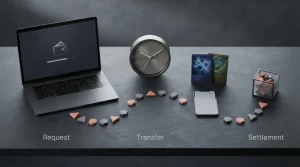
There is another timing distinction. A withdrawal request, its review, a transfer sent by the operator and the required blockchain confirmations are four different stages. The operator says it sends many crypto withdrawals promptly, but may manually examine flagged cases. That is a statement about dispatch, not a guaranteed arrival time. Blockchain congestion, recipient-wallet settings and verification conditions can change the actual completion experience.
For account ownership and identity-document requirements, the account and verification guide covers the role of two-factor authentication and KYC checks without treating them as substitutes for transfer confirmation.
From a blockchain broadcast to account credit
A cryptocurrency deposit passes through at least two systems: the asset network and the operator’s internal ledger. The sending wallet creates a transfer and broadcasts it to the network. Miners or validators include it in the relevant chain’s record; the receiving service then observes the required confirmations and credits the account. A transaction marked as “sent” in a wallet can therefore precede a balance appearing inside the casino.
500 Casino’s help centre gives a Bitcoin example requiring one network confirmation before deposit credit. That is a stated example for BTC, not a universal rule to apply to every supported coin. Different networks can use different confirmation rules, and recipient-side processing may occur after the transfer has appeared on a public explorer.
- Creation: a sending wallet selects an amount, destination address and any relevant network or tag information.
- Broadcast: the transfer enters the blockchain’s pending transaction pool.
- Confirmation: inclusion on the network progresses according to that asset’s mechanism.
- Account credit: the receiving system recognises the transfer and assigns value to the appropriate ledger.
Errors in the address, chain or destination-tag field can be costly because a blockchain transfer is generally difficult or impossible to reverse. A coin ticker is not enough to establish chain compatibility, especially for tokens that circulate over multiple networks. A sender must distinguish the asset label, receiving network and exact recipient details shown by the intended transfer service. This explanation is about technical risk; it does not imply a supported UK deposit path.
The confirmation mechanism also explains why no universal minute-by-minute speed should be attached to all cryptocurrency deposits. Block creation, transaction demand and internal processing are distinct sources of delay, and the operator’s BTC example cannot define the speed of ETH, LTC, XRP or USDT transfers.
Minimum amounts depend on the funding category
500 Casino’s payment help gives approximate examples in US dollars: around $0.30 for skins, about $3 for real-money payments and a cryptocurrency minimum starting around $0.60, depending on the coin. These are not fixed thresholds for every item, card or coin. The actual minimum depends on the chosen deposit method, and a skin’s accepted value can change with market prices.
A low deposit minimum does not mean a low total transfer cost. Cryptocurrency network fees affect how much leaves a wallet and how much reaches the destination. Individual coins can also have different minimum crediting requirements. For skins, both the market value and the eligibility of the specific item matter.
The welcome-package minimum is a separate promotional condition. The operator’s welcome material refers to an eligible first deposit above $25; that does not replace the ordinary deposit minimum for the selected payment method. The bonus terms overview explains promotional requirements separately from payment transfers.
Payment methods, balances and withdrawal routes
500 Casino distinguishes between how funds enter the account and how value can leave it. Cryptocurrency deposits are held in balances for the deposited asset, while real-money payments, vouchers and skins are credited to MAIN under the help-centre balance model. The table compares these funding categories without assigning unsupported per-coin withdrawal minimums or fixed transaction fees.
| Funding method | Balance credited | Withdrawal route described |
|---|---|---|
| Cryptocurrency | Balance for the deposited coin | The same coin or eligible P2P skins, subject to account and wallet restrictions. |
| Real-money payments | MAIN | No direct fiat cashout. Crypto or eligible skins may be available under the account rules. |
| Vouchers and gift cards | MAIN | No direct fiat cashout. Withdrawal conditions apply before value can leave the account. |
| CS2 and Rust skins | MAIN | Crypto or eligible P2P skins, subject to the platform’s account and trade rules. |
The help centre names Bitcoin (BTC), Ethereum (ETH), Litecoin (LTC), XRP and Tether (USDT) among cryptocurrency withdrawal options; this is not a complete or UK-specific availability list. Deposit minimums, withdrawal amounts, supported token networks and transaction costs depend on the actual asset and transfer route. Network fees can reduce the sum received. The current terms also impose wallet-origin and account checks, so a route described for a balance is not an unconditional withdrawal entitlement.
Fiat-funded deposits and vouchers
The platform’s help centre discusses real-money deposits, prepaid or virtual cards, and voucher or gift-card funding. These methods feed the MAIN balance rather than a coin-specific balance. Their inclusion in international help material does not establish availability in Great Britain. A card-funded deposit also does not mean the account can be paid out directly to a card or bank account.
CS2 and Rust skin transfers
Skin transactions involve specific game-related virtual items and P2P trade arrangements. The value of an item depends on the current market and the exact item transferred. A skin deposit, a marketplace sale and a withdrawal as a virtual item can involve different mechanics even though they all touch the same account ecosystem.
Why deposit turnover is separate from bonus wagering
The operator’s terms require the value of a deposit to be wagered at least once before withdrawal, independently of any additional wagering attached to a bonus. This 1× deposit turnover is not a transaction fee, a deposit minimum or a guarantee of withdrawal approval. Identity checks and wallet-origin restrictions can still apply.
Bonus-balance wagering, by comparison, is a condition on promotional credit, not a statement about the minimum transfer needed to send crypto. Keeping the two calculations separate prevents a claim about game turnover from being mistaken for a payment-network fee.
Payment and balance questions
Which cryptocurrency withdrawals does 500 Casino list?
The operator names Bitcoin, Ethereum, Litecoin, XRP and Tether as cryptocurrency withdrawal assets. The network and transfer details depend on the asset and the actual transfer flow.
How are MAIN and crypto balances different?
500 Casino separates cryptocurrency-specific balances from MAIN. Fiat, voucher and skin funding enters MAIN under its help-centre model; outgoing crypto and skin routes can depend on the ledger type and the terms governing the account.
Can a real-money deposit be withdrawn directly as fiat?
The operator’s payment guidance describes crypto and P2P skin withdrawals rather than direct real-money cashouts. An incoming fiat-funded method therefore does not imply an equivalent bank or card payout.
Does one confirmation mean every crypto deposit is instant?
No. One Bitcoin network confirmation is the operator’s example for BTC deposit credit. Other assets and the operator’s own processing can follow different steps.
Why the balance type matters before a payout
The key feature of 500 Casino payments is the separation between how money or items enter the account and the form in which value may later leave it. Bitcoin and other cryptocurrency ledgers expose the account to price changes and on-chain transaction costs. MAIN balances, gift cards and skin transfers follow a different internal accounting path, while outgoing transfers emphasise cryptocurrency and P2P items.
Understanding the funding category, credited ledger and destination-ownership rule makes individual payment terms easier to interpret. Network confirmation is not operator approval; a deposit minimum is not a withdrawal minimum; and a payment method accepted globally is not necessarily offered to a customer in Great Britain. The overall financial risk includes gambling losses as well as possible crypto volatility and irreversible transfers.